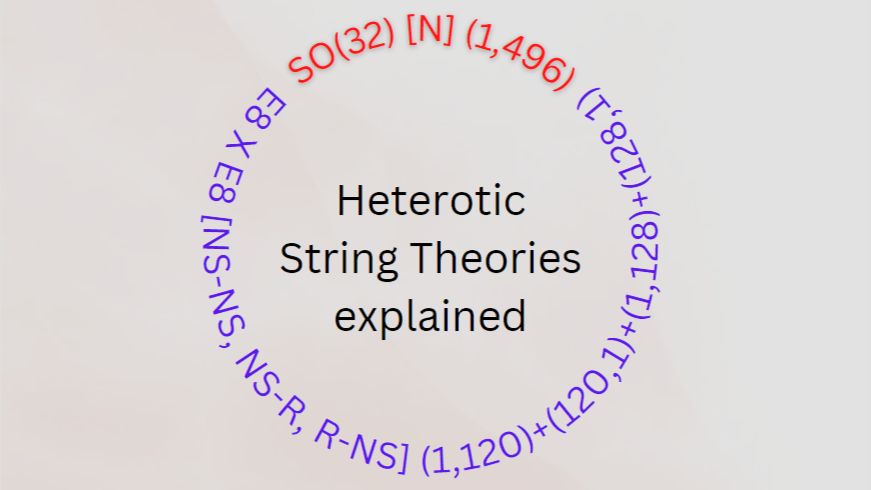
Why do we have two heterotic theories i.e. SO(32) heterotic and E8 X E8 heterotic? How do we come to this conclusion? I will present some results without derivation because their derivation requires calculations. A very basic understanding of quantum field theory is assumed and it is better if the reader has already read my type II theory post.
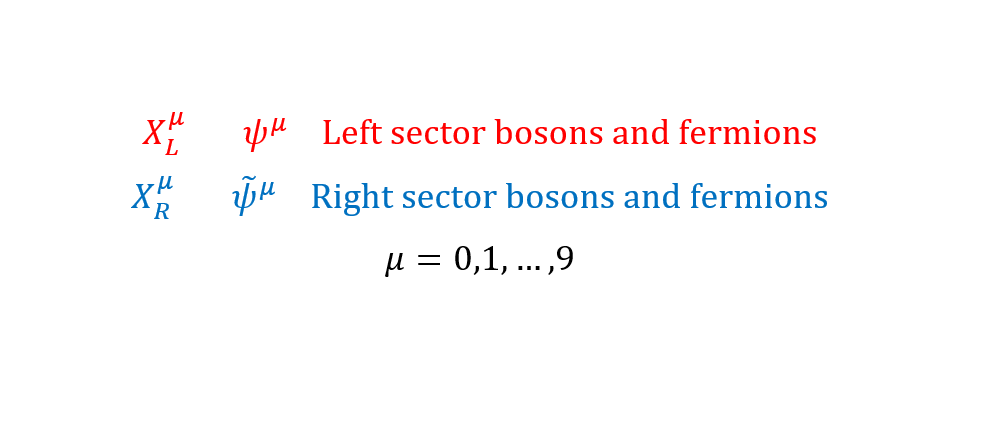
In Type II superstring theories, we have 10 bosons and ten fermions but there are two copies of them which are called the left and right-sector copies. For most of the results, the left and right bosons and fermions decouple from each other.
We can now make a new theory by keeping the right-handed bosons and fermions but in the left sector, we can take the bosonic string bosons. But the dimensions of bosonic and superstring theories are 26 and 10 respectively. So, how to solve this problem?
A dimension in the string theory context means a left sector and right sector boson coupled together. So, we can have only ten bosons in the left sector. But is that enough? The answer is no.
For a consistent string theory, we need to avoid an anomaly called the Weyl anomaly. For that, the central charge of the matter theory (made up of bosons and fermions) is negative to the central charge of a system called the ghost system.
In superstring theory, the ghost central charge is -15. The central charge due to a boson is +1 and due to a fermion is +1/2. So, 10 bosons and fermions give a central charge of +15. So, everything is fine in the right sector which contains these 10 bosons and fermions.
The left sector the bosonic string variables. The ghost charge for this theory is -26. We have 10 bosons in the left sector and thus, it gives a central charge of +10. We need something that can give the additional +16 central charge. Here is where things get interesting.
One way to get this additional +16 central charge is to have additional 32 fermions in the left sector. For these fermions, we need to choose the boundary conditions. We can have antiperiodic or periodic boundary conditions for each of them.

A fermion with an antiperiodic boundary condition is said to be in Neveu Schwarz (NS) sector and A fermion with a periodic boundary condition is said to be in Ramond (R) sector. Each of the 32 fermions can be either in NS or R sector.
We can choose all of the left fermions to be in the same sector. It means that we can mix all of these fermions by an SO(32) transformation without changing the theory. So, there is an SO(32) symmetry of this theory.
The massless excitations, in this case, are interesting. They contain a set of excitations that live in the adjoint representation of SO(32) gauge group. All massless excitations are in NS sector and the R sector doesn’t have any. This theory is called SO(32) heterotic theory.
We can also choose half (i.e. 16) of the left fermions to be in the same sector and the other half (i.e. 16 again) to be in the same sector. So, there are four sectors in this theory. NS-NS, NS-R, R-NS, and R-R. We again investigate the massless excitations of this theory but only due to these left fermions.

Since the first 16 fermions hav is in the same sector with the same boundary conditions, we can mix them by an SO(16) transformation. The other 16 fermions can be mixed by another SO(16) transformation. We will denote the first SO(16) group as SO(16) and the other SO(16) group as SO(16)’.
The NS-NS and R-R sectors of this theory are a bit like the NS and R sectors of the SO(32) theory but there are some differences. The R-R sector again doesn’t have massless excitations. NS-NS sector in this new theory has massless excitations but the excitations now live in an adjoint representation of one SO(16) group but the singlet representation of the other SO(16) group.
The NS-R sector of this new theory contains massless excitations that live in a spinor representation of SO(16) but a singlet representation of SO(16)’. The R-NS sector contains massless excitations that live in a spinor representation of SO(16)’ but a singlet representation of SO(16).
The adjoint representation of SO(16) is 120 dimensional and the spinor representation of SO(16) in which the massless excitations of R-NS and NS-R sectors live are 2^7=128 dimensional.
If we label the massless excitations of this new theory by their (SO(16),SO(16)’) representations, then they are;
NS-NS: (120,1)+(1,120)
NS-R: (1,128)
R-NS: (128,1)
Recall that we’re only talking about massless states due to the left fermions.
So, the massless states live in the 120+128 representation of SO(16) or the 120+128 representation of SO(16)’. 120+128 is not the adjoint representation of SO(16) and we have learned from QFT that gauge bosons should live in the adjoint representation of the gauge group.
Is this a flaw? Actually no. The full group is not manifest to us in this formalism. To see the full group, we need to look for a group that is 120+128=248 dimensional (i.e. it has 248-dimensional adjoint representation), has SO(16) as a subgroup, and its adjoint rep transforms like 120+128 under SO(16) action. This group is E8.
Since the apparent symmetry of this new theory was SO(16) X SO(16)’ and we learned that these SO(16) groups sit in E8 groups, we deduce that the actual gauge group of this new theory should be E8 X E8. This theory is called E8 X E8 heterotic theory.
This construction of heterotic theories is called the fermionic construction because we took 32 fermions to complete the central charge of +16. We could have taken 16 bosons. But these 16 bosons would be coordinates on a 16-dimensional torus. It turns out that this construction gives the same heterotic theories.
This bosonic construction will be covered in a later post. In the fermionic construction, we can partition the left fermions into groups of 8,4,2, or 1 instead of 16 (as we did in the E8 X E8 theory). Theories resulting from these partitions aren’t supersymmetric and thus, not acceptable.
In both of the heterotic theories, we have additional massless excitations that aren’t due to the left fermions but due to the bosons. They give the same states as the NS+ states in type II theories (this was covered in a previous post).
 Hassaan Saleem