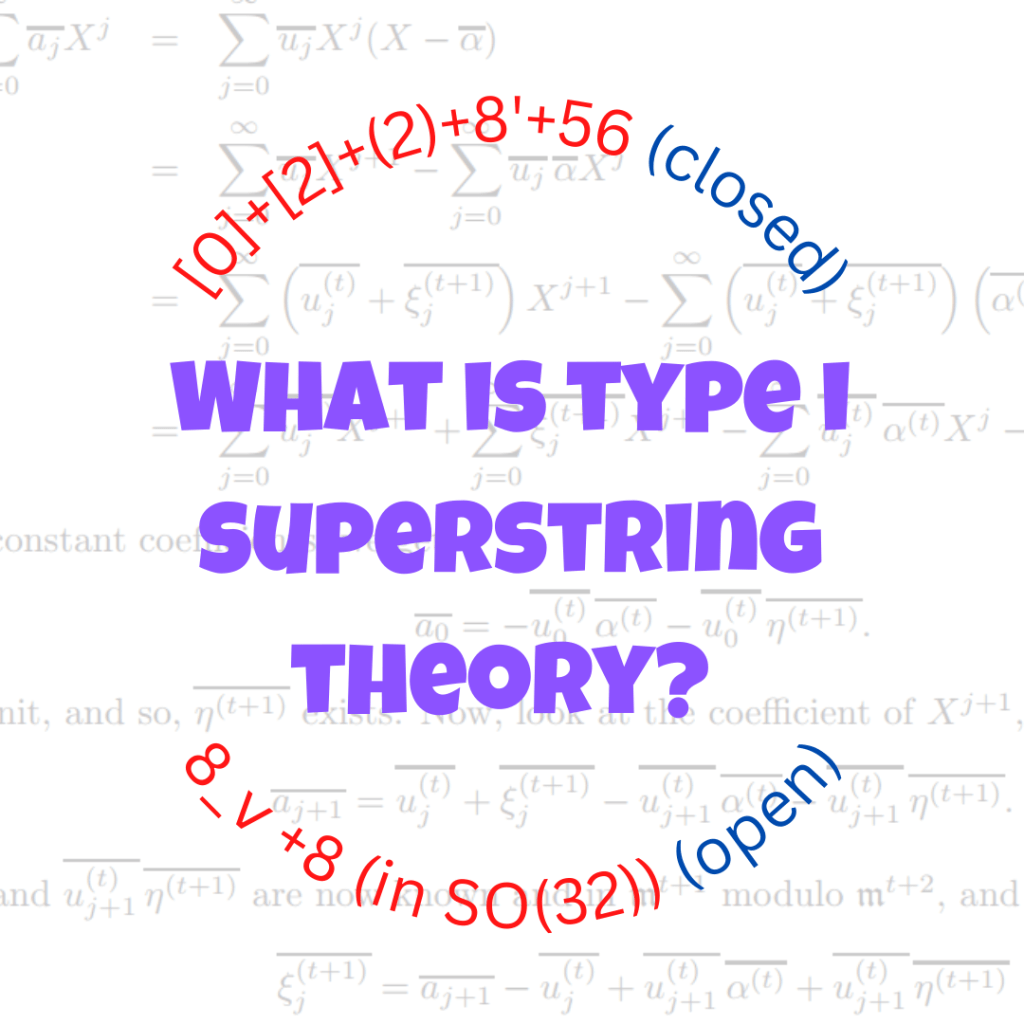
So we have done a post on type II strings and a post on heterotic strings in the past. Now, let’s do a post on type I strings to cover all 5 known consistent superstring theories.
To follow this post, it would be better to re-read my post on type II strings first because I will assume the understanding of the material covered there.
As always, I might give some results without derivations as they require calculations. An interested reader can consult textbooks on this subject e.g. Polchinski.
To make the consistent type I string theory, we need to construct another theory called type I unoriented closed string. To do this, we need some facts about the (NS+, NS+), (NS+, R+), (NS+, R-),(R+, R+), (R-, R-), and (R+, R-) sectors.
We need to know the massless spectrum of these sectors (i.e. what kind of excitations can be found in these sectors). To follow the discussion ahead, note that [n] means n rank antisymmetric tensor, 8 means spinor with positive chirality and 8′ means a negative chirality spinor.
The massless spectra of these sectors are as follows;
(NS+,NS+) : [0]+[2]+(2)
(R+,R+) and (R-R-) : [0]+[2]+[4]
(R+, R-) : [1]+[3]
(NS+,R+): 8’+56
(NS+, R-): 8+56′
where (2) is a second-rank symmetric tensor, 56 is a gravitino with positive chirality, and 56′ is a gravitino with negative chirality.
Now, we introduce the concept of being unoriented. When we do normal string theory, we choose to parameterize the worldsheet with parameters, and at some time slice, the parameter along the string increases in one direction. So, the string has an orientation.
Introduce an operator called the worldsheet parity operator. Denote it by Ω. Ω reverses the parameter on the string and if the string is unaffected by the orientation, it should be in a state that is an eigenstate of Ω.
Since applying Ω twice gives back the same thing (because if you reverse the parameter on the string and then reverse it again, you get the original configuration), the eigenvalue squared should be 1, and thus, the possible eigenvalues are +1 or -1.
Now, we define the unoriented string to be a string that only exists in eigenstates of Ω with eigenvalue +1. Why not -1? Well, this is a bit subtle to describe but the short answer is that the -1 eigenvalue isn’t conserved in string interactions. Ω=+1 eigenvalue does.
Now, we start with type IIB theory and impose Ω=+1 constraint on it. From the type IIB sectors, it turns out that in (NS+, NS+) sector, [2] goes away. In the (NS+, R+) and (R+, NS+) sectors, only a linear combination of states that obeys Ω=+1 survives. This gives only one 8’+56.
From the (R+R+) sector, it turns out that only [2] survives. So, the Ω=+1 constraint gives the following massless spectrum;
[0]+(2)+8’+56+(2)
The theory that we just made (i.e. by imposing Ω=+1 on type II B) is called type I closed string theory.
The important difference between this theory and type II theory is that it has only one gravitino and thus, it can’t have N=2 supersymmetry but N=1 supersymmetry. This fact will be crucial later. However, this theory is not the end of the discussion because this theory turns out to be inconsistent.
Now, bring in open strings. Open strings don’t have two separate left and right-moving sectors. So, to specify their sector, we don’t need to form pairs like (NS+, R+), etc. So, the possible sectors for open strings are NS-, NS+, R+, and R-.
Recall from my post on type II strings that type II strings have a GSO projection (why it should be the case was explained there). It turns out that there should be a GSO projection for open strings as well to couple consistently with type I or type II closed strings.
This GSO projection allows only two combinations of sectors of open strings. The possibilities are as follows with their massless excitations;
I : NS+, R+ : 8v +8
I’ : NS+, R- : 8v +8′
where 8v is an eight-dimensional vector and 8 & 8′ are spinors as explained before. The two possibilities are labeled as I and I’
Now, we can see that in each possibility, open strings have one spinor and thus, they can’t have N=2 supersymmetry but only N=1. So, they can’t couple consistently to type II closed strings but only to type I closed strings.
But the type I closed strings have Ω=+1. So, open strings must also have Ω=+1 for consistent interactions (as mentioned before, Ω=+1 is the only eigenvalue that gives consistent interactions). So, the open strings are also unoriented.
Ok, that’s fine but which possibility (among I and I’) can actually couple to type I closed strings? Since the type I closed string theory has an 8′ spinor, it turns out that spacetime supersymmetry requires the open strings to have an 8 spinor. This is the case for the possibility I and not for I’.
Moreover, open strings have gauge fields on their endpoints (they are formalized by extra degrees of freedom on their endpoints named Chan Paton indices). It can be shown that for unoriented open strings, the gauge group is SU(n) or Sp(n) where Sp(n) is a symplectic group.
So, the type I open plus closed superstring theory has the following massless excitations;
[0]+(2)+8’+56+(2) +8v +8
where the last two terms come from the open strings and they are either in the SO(n) gauge group or Sp(n) gauge group.
Are these theories (we have one theory for each possible gauge group) consistent? As explained in my previous post on the cancellation of massless divergences only the SO(32) gauge group gives a consistent theory.
So, the consistent type I theory is only one i.e. type I open plus closed superstring theory with gauge group SO(32). Its massless spectrum is
[0]+(2)+8’+56+(2) +8v +8
with the last two excitations living in the SO(32) gauge group. It turns out that they are in the adjoint representation (This is because supersymmetry commutes with gauge symmetry).
 Hassaan Saleem