
I just love how the cancellation of massless divergences (also called tadpole cancellation) in open string theory determines the allowed gauge group. A small explanation of this thing follows but it will require some familiarity with basic QFT.
In our context, a divergence is a quantity that is infinite. Cancellation of divergences mean that the sum of all the divergent quantities turn out to be zero.
In open string theory, there are divergences that appear due to massless excitations of the string when the worldsheet of the string has a single loop. These worldsheets include torus, Klein bottle, cylinder, and Mobius strip. Therefore, we will be talking about massless one-loop divergences.

Moreover, open string theory carries gauge fields on its endpoints. These gauge fields live in a gauge group. We can determine that these gauge groups can be either an SO(n) group with n>1 or a symplectic group Sp(2n). Symplectic groups might look fancy but they are used even in classical and hamiltonian mechanics.
Now back to the worldsheets. The torus doesn’t have massless divergences. In bosonic string theory, the torus has a divergence due to tachyon but that isn’t our concern as it goes away in superstring theory. The remaining three worldsheets have massless divergences in both bosonic and superstring theory.
When we add up all the divergences due to these three worldsheets, we see that the symplectic group can’t be the gauge group because if it is the gauge group, the divergences never cancel. Moreover, we also deduce that the only gauge group possible is SO(8192) in bosonic string theory and SO(32) in superstring theory.
For readers who want some detail, the following diagram gives the results for the massless one-loop divergences in bosonic and Type I string theories. The rest of the factors aren’t important here. Only the n-dependent factors are important to deduce when these divergences vanish.
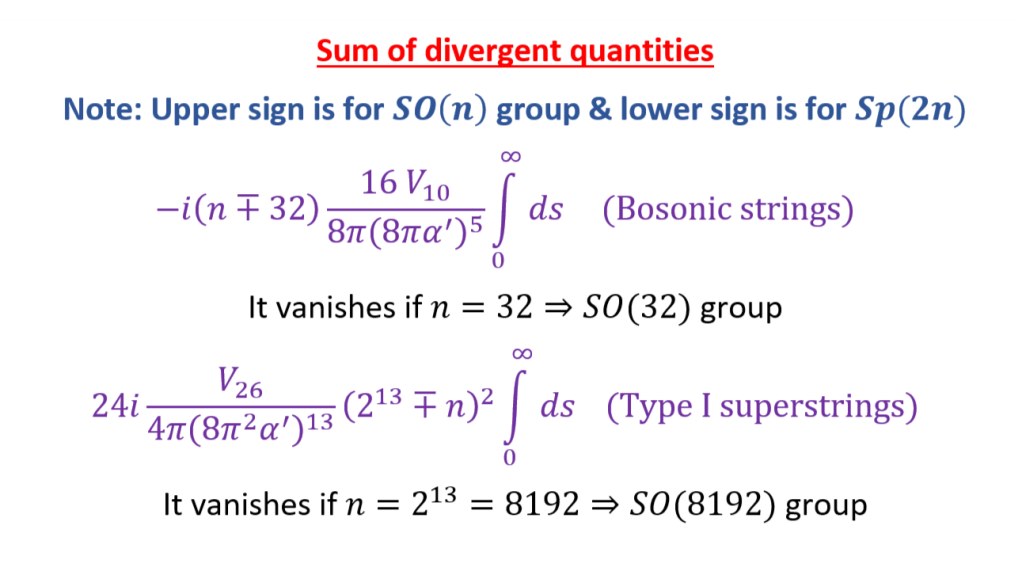
These numbers might look arbitrary but here is a pattern. 8192 is the 13th power of 2 and 13 is the half of 26, the number of dimensions in bosonic string theory. Moreover, 32 is the 5th power of 2, and 5 is the half of 10, the number of dimensions in superstring theory. Of course, these numbers aren’t determined in this way. They are determined through careful calculations of the divergences.


One response to “Gauge groups in bosonic and Type I string theories”
[…] theories (we have one theory for each possible gauge group) consistent? As explained in my previous post on the cancellation of massless divergences only the SO(32) gauge group gives a consistent […]
LikeLike